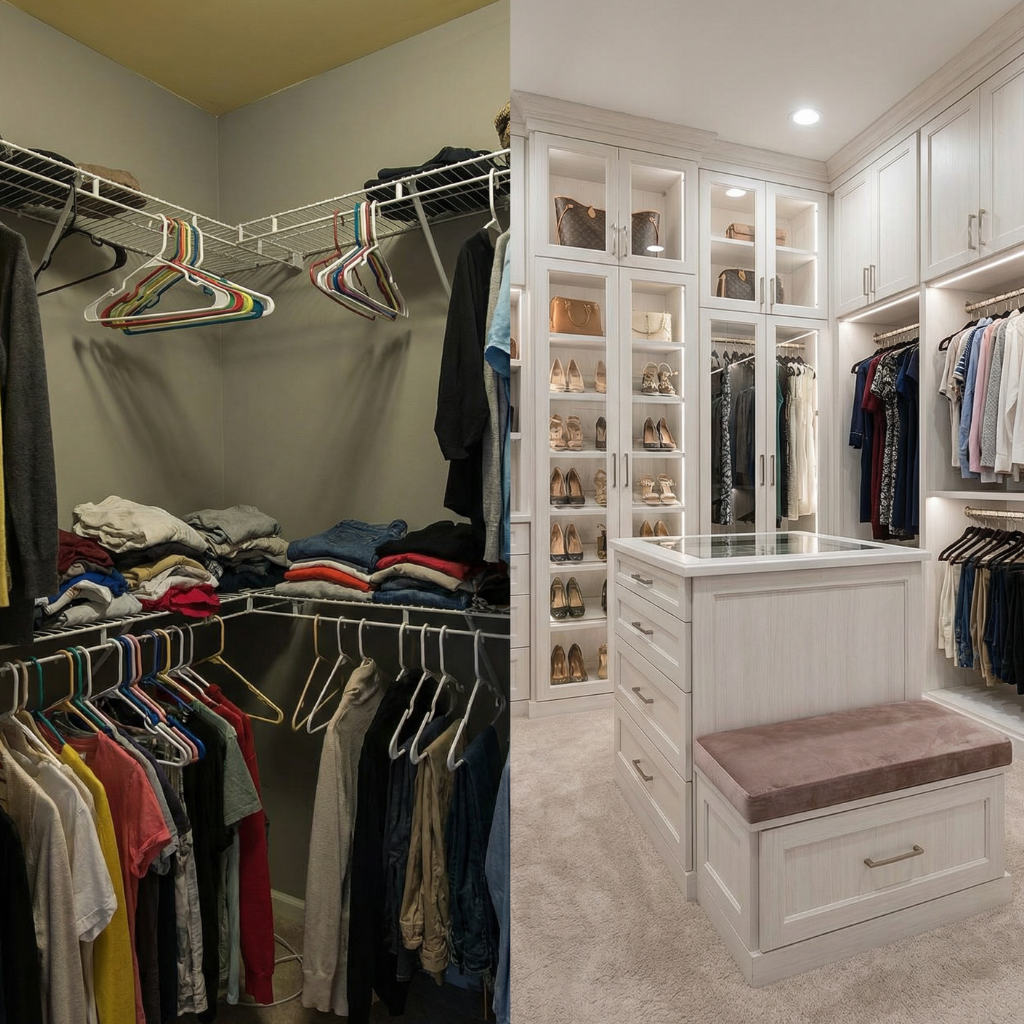
See it before you build it
Upload a photo of your closet and get a redesign in about a minute. Nine styles, seven closet types, and a measured plan with a cut list.

California Closets is the default name in custom closets and the most expensive mainstream option. Here is what the alternatives cost, what you give up, and where the price difference actually comes from.
Prices are typical US installed figures for 2026 and move with your market. The lead time column matters more than people expect: a custom order in February is a closet in April.
| Option | Reach-in | Walk-in | Lead time | Strength | Trade-off |
|---|---|---|---|---|---|
| California Closets | $2,000 - $5,000 | $5,000 - $15,000 | 4 - 8 weeks | In-home design, install, warranty, wide finish range | The highest-priced mainstream option, and the design visit is a sales visit |
| Local cabinet shop | $1,200 - $3,500 | $4,000 - $12,000 | 3 - 8 weeks | Same or better materials, real hardwood available, you talk to the maker | You have to find a good one and manage the project yourself |
| Container Store Elfa | $500 - $1,500 | $1,500 - $4,000 | Days | Adjustable, movable, frequently discounted, install optional | Hangs off a top rail, so it reads as a system rather than as millwork |
| IKEA PAX | $400 - $1,200 | $1,200 - $3,500 | Same day to 2 weeks | Cheapest route to a full-height built-in look, huge accessory range | Fixed module sizes, and fillers and scribing are on you |
| Melamine kit, self-installed | $250 - $800 | $800 - $2,500 | Same day | Lowest cost per linear foot for a closed-panel look | Only works if your walls and floor are close to square |
| Plywood, built yourself | $200 - $600 | $600 - $2,000 | A weekend or three | Exact fit, any dimension, best cost per foot by a distance | Needs a track saw, an edge bander or iron-on edging, and patience |
Strip a custom closet quote down and there are four line items: panels, hardware, labor and design. Panels are commodity: 3/4 in. melamine or thermally fused laminate, bought by everyone from the same handful of mills. Hardware is where the national brands are genuinely good, because soft-close undermount slides and adjustable hanging systems cost real money.
Labor and design are the difference. An in-home designer, a CAD drawing, a shop that cuts to that drawing and an installer who fixes the mistakes on site is a service worth paying for on a complicated room. On a 6 ft reach-in with square walls, it is a service you can skip.
Straight wall, standard ceiling, square corners: buy PAX or a melamine kit and spend the difference on drawers and lighting. Angled ceiling, a window in the run, a chimney breast, or a walk-in with an island: pay someone, because that is exactly where modular systems fail and where a shop earns its margin.
Either way, decide the layout before you get quoted. Walking into a design appointment with a render of your own closet and the wall dimensions written down changes the conversation from what would you like to here is what I want, quote it.
Render your closet in the styles you are considering, check the standard dimensions against the space you have, and compare the numbers on the remodel cost page before anyone visits.
You are buying a service, not just panels: a designer visits, measures, draws it, and an installer fits it with a warranty behind the work. The panels themselves are usually 3/4 in. melamine or thermally fused laminate, the same substrate a local shop uses.
A local cabinet shop. Same materials, often better hardware, and you can specify hardwood veneer that the national brands charge a heavy premium for. Expect to spend 20 to 40 percent less for equivalent work, and to do more of the coordinating yourself.
For a straight wall with standard ceiling height, yes, and it is the best value on the list. It struggles with angled ceilings, out-of-square walls and any width that is not a multiple of the module. Custom fillers and a scribed panel at each end fix most of that.
Give every supplier the same drawing: wall lengths, ceiling height, and the split between hanging, drawers and shelves. Without a fixed spec you get quotes for different closets, which is the main reason the numbers come back so far apart.
Upload a photo of your closet and get a redesign in about a minute. Nine styles, seven closet types, and a measured plan with a cut list.