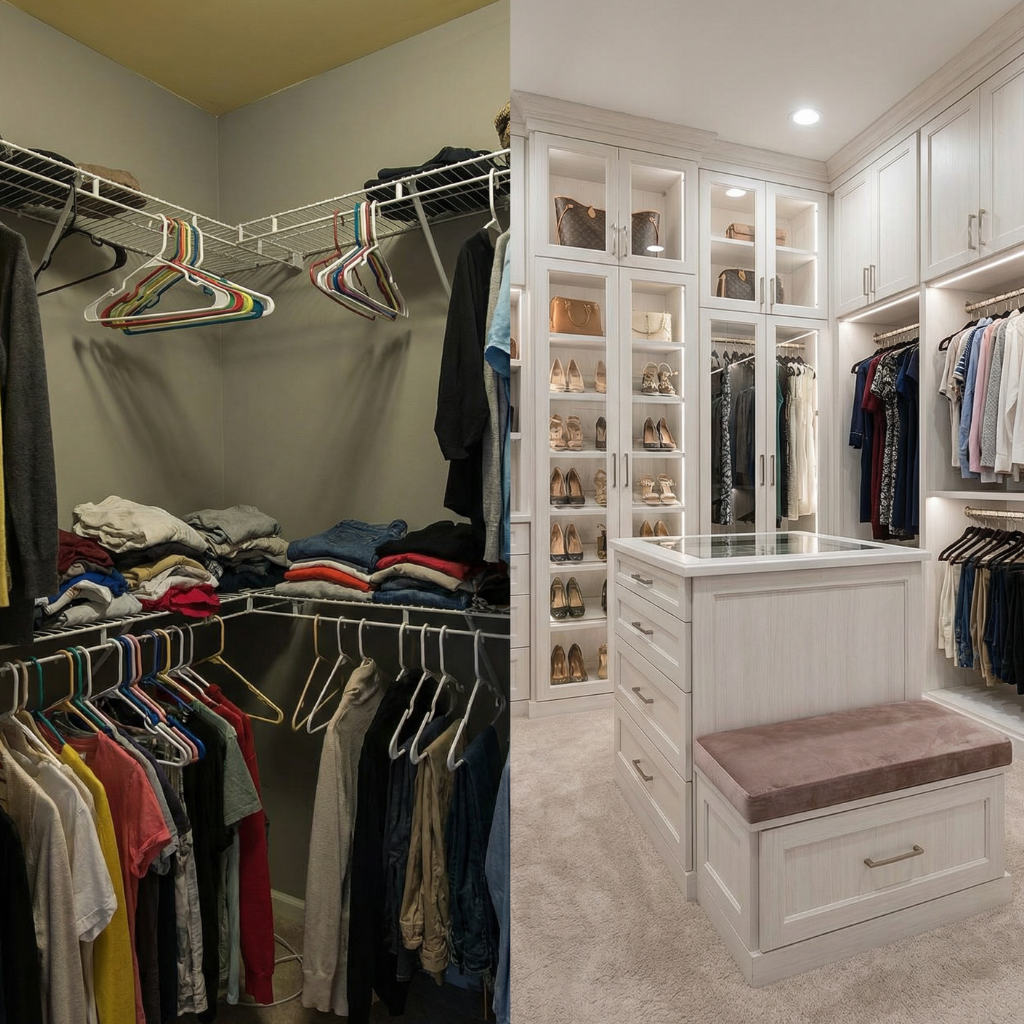
Let the planner do the arithmetic
Enter your wall lengths and how you want to split hanging, drawers and shelves. The app lays out the bays to these standards and gives you an elevation and a cut list.

Every number below comes with the reason behind it. These are the same standards the app's planner uses when it lays out bays, rods and drawers, so a design that follows them will actually fit your clothes.
Hanging is measured as clear space below the rod, not as rod height. Get this wrong and coats drag on the shelf below, which is the single most common complaint about a new closet.
| What hangs there | Clear space needed | Rod position | Why |
|---|---|---|---|
| Long hang (dresses, coats, robes) | 68 in. | Rod at 70 in. | The tallest garment most people own is a maxi dress at about 64 in. |
| Medium hang (pants folded on the bar, jackets) | 45 - 50 in. | Rod at 48 in. | Suit jackets need 40 in., trousers folded over a bar need 45 in. |
| Short hang (shirts, blouses, skirts) | 38 - 42 in. | Rod at 40 / 80 in. for double hang | 38 in. is the minimum the app's planner will allocate to a hang tier |
| Double hang, top rod | 38 in. above | 80 - 84 in. | 84 in. is the reach limit for most adults without a stool |
| Kids hang | 24 - 30 in. | 30 - 46 in. by age | Kids garments are short, so you can stack three tiers where adults fit two |
Uniform shelf spacing wastes about a quarter of the volume of a closet. Vary it by what goes on the shelf: shoes need 8 inches, sweaters need 16, and nothing needs 24.
| What sits on it | Vertical spacing | Shelf depth |
|---|---|---|
| Folded shirts and tees | 12 - 13 in. | 14 - 16 in. |
| Sweaters and jeans | 14 - 16 in. | 16 in. |
| Shoes, flat shelf | 8 in. | 12 - 14 in. |
| Boots | 14 - 18 in. | 14 in. |
| Handbags | 14 - 16 in. | 14 in. |
| Towels and linens | 13 - 16 in. | 14 - 16 in. |
| Canned goods (pantry) | 8 - 10 in. | 12 - 14 in. |
| Bins and luggage (top shelf) | 16 - 20 in. | 24 in. |
These are the construction numbers. They decide whether the closet holds together and whether you can stand in it.
| Measurement | Standard | Why |
|---|---|---|
| Panel thickness | 0.75 in. (19 mm) | 3/4 in. plywood or melamine. Thinner sags |
| Run height | 84 in. standard | Or full height to the ceiling, with the top bay for storage |
| Run depth | 24 in. hanging, 16 in. shelves only | A hanger is 22 in. wide |
| Bay width | 18 - 36 in., 27 in. ideal | Over 36 in., a 3/4 in. shelf visibly sags under knits |
| Toe kick | 3.5 in. high | Keeps the bottom drawer clear of baseboards and dust |
| Rod clearance below shelf | 1.5 in. | Less than this and hangers will not slide onto the rod |
| Drawer face height | 8 in. typical | 6 in. for accessories, 10 - 12 in. for sweaters |
| Drawer stack height | Max 48 in. | Above waist height a drawer becomes a shelf you cannot see into |
| Walkway clearance | 36 in. minimum | 42 in. if two people use the closet at the same time |
The numbers above are the general case. Each closet type has its own page with the depths and spacings that apply to it.
Minimum room width, one wall of storage: 60 in. (5 ft)
Depth: 24 in. standard, 22 in. minimum
Depth, hanging: 24 in.
Shelf depth: 14 - 16 in.
Shelf depth, cans and jars: 12 - 14 in.
Rod height, ages 2-5: 30 - 34 in.
Bench height: 18 in.
70 inches for a single rod, which gives 68 inches of clear hanging below it. For double hang, put the top rod at 80 to 84 inches and the bottom at 40 to 42, which leaves both tiers with the 38 inches a shirt needs.
24 inches for anything with a hanging rod. That comes from the hanger, which is 22 inches wide, plus clearance. For shelves only, 14 to 16 inches is enough and anything deeper hides what is at the back.
13 inches is the working default for folded clothes. Go to 8 inches for shoes and canned goods, 14 to 16 for sweaters and jeans, and 16 to 20 for the top shelf where bins and luggage go.
Between 18 and 36 inches, with 27 as the sweet spot. Narrower than 18 and a hanger will not fit across; wider than 36 and a 3/4 inch shelf bows in the middle once you load it.
36 inches minimum, which is the same as a hallway. That is enough to stand, open a drawer and pull a garment out. 42 inches if two people share the closet in the morning.
Roughly 12 to 20 garments per linear foot of rod for shirts on slim hangers, and 6 to 10 for coats and thick knits. A 6 ft double-hang section, which is 12 linear feet of rod, holds about 150 to 240 shirts.
Enter your wall lengths and how you want to split hanging, drawers and shelves. The app lays out the bays to these standards and gives you an elevation and a cut list.