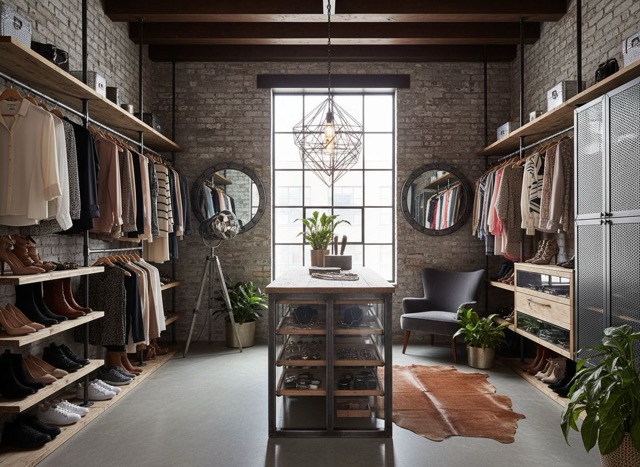
Industrial is the only style on the list that most people can actually build themselves, which is why it keeps showing up in rentals and lofts. The parts are off-the-shelf: black iron pipe, flanges, scaffold boards, steel angle. Nothing is hidden and nothing needs a cabinet shop.
| Surface | Use | Note |
|---|---|---|
| Structure | Matte black steel | Pipe, brackets, hanging rails |
| Wood | Reclaimed or dark-stained pine | Chunky, 1-1/2 in. or thicker |
| Walls | Brick, concrete or deep charcoal | Do not drywall over the good wall |
| Textiles | Leather and canvas bins | Rather than fabric baskets |
| Element | Specification |
|---|---|
| Rods | 3/4 in. or 1 in. black iron pipe with floor flanges |
| Shelves | 1-1/2 in. solid timber on steel L brackets |
| Fixings | Visible bolts, no concealed cam locks |
| Lighting | Exposed filament bulb or a wire cage fixture |
| Storage | Wire baskets and leather-handled crates |
The cheapest style to build and the easiest to DIY. Pipe and flanges are the entire hardware list.
Ranges are typical US installed prices and vary by market. Compare them against the full closet remodel cost breakdown.
In the app, use Transform Closet with a photo of your room and pick Industrial. If you are starting from nothing, use Dream Closet and paste this description:
“Industrial closet, black iron pipe clothing rods, thick reclaimed wood shelves on steel brackets, exposed brick wall, wire baskets, exposed filament bulb, no cabinet doors”
Yes. 3/4 in. pipe supported at both ends carries a normal hanging load over spans up to about 4 ft. Past that, add a center support flange or move to 1 in. pipe. Sag on a long unsupported span is the usual complaint.
It works better as an open wardrobe on a wall than inside a small closed closet, because half the style is the exposed structure. Shut it behind a door and you are left with plain pipe.