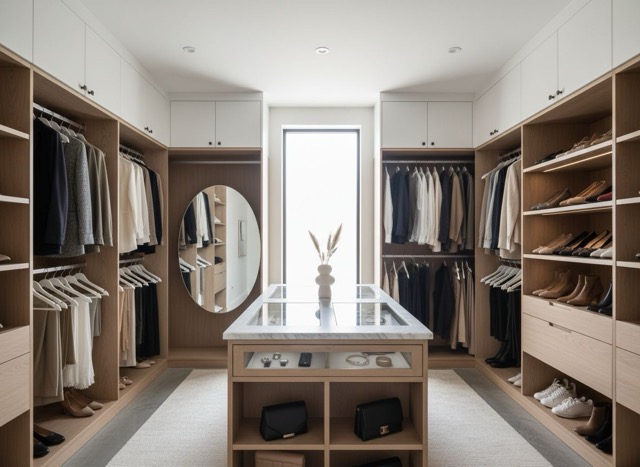
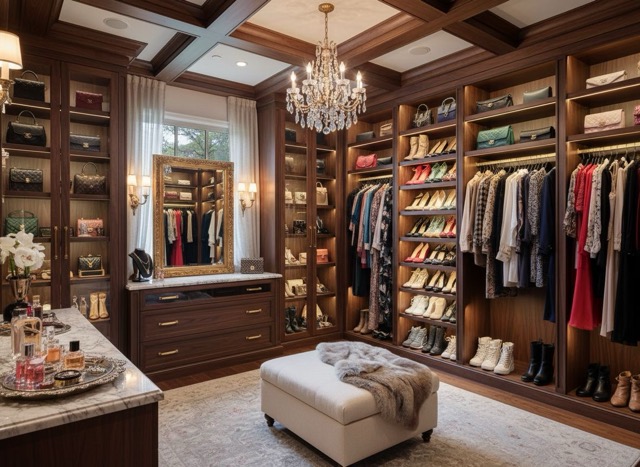
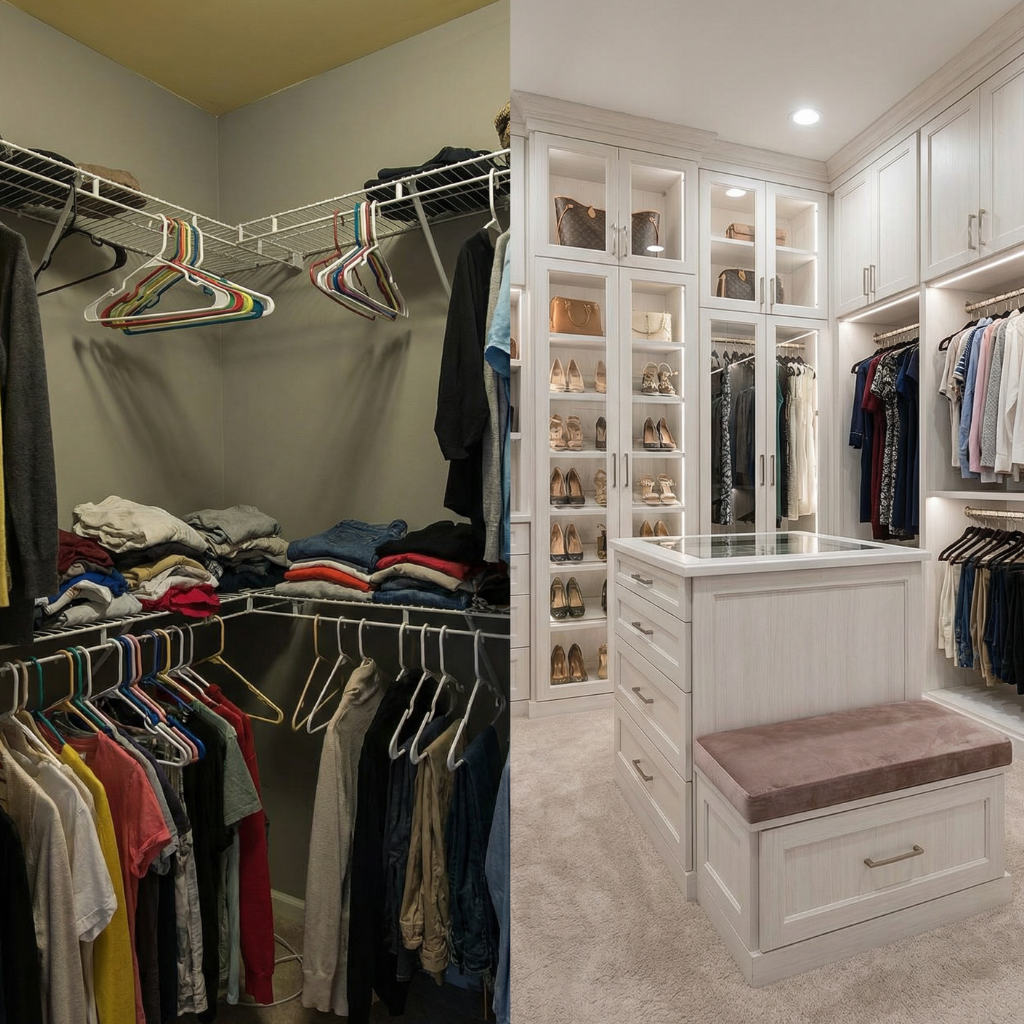
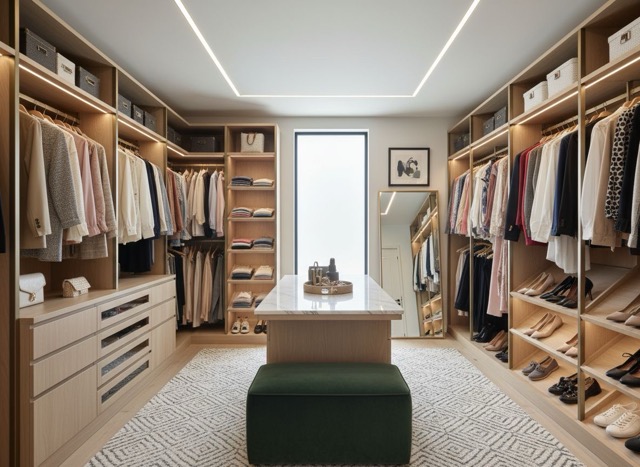
Boutique borrows from retail merchandising instead of from cabinetry. The idea is that a share of your clothes hang face-out, like a shop rail, so you see the garment instead of a row of shoulders. It needs fewer clothes per linear foot than any other style, which is the trade you are making.
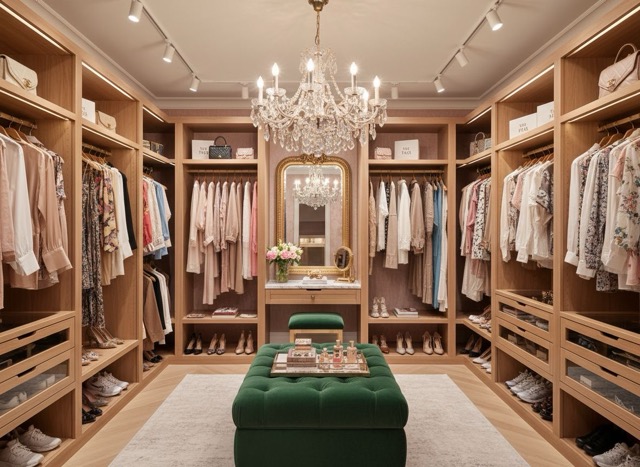
| Surface | Use | Note |
|---|---|---|
| Cabinets | Soft neutral: greige, bone, pale sage | Backdrop, not the star |
| Accent | One saturated color on the back panel | Behind the display bay only |
| Metal | Brass or chrome retail rails | Face-out arms are a retail part, not a closet part |
| Floor | Wood with a small rug | Boutique reads as a room, not a storage space |
| Element | Specification |
|---|---|
| Face-out arm | Straight or waterfall arm, 12-16 in. |
| Shoe shelves | Angled 10-15 degrees, 8 in. vertical spacing |
| Lighting | Track or puck spots plus shelf LED |
| Mirror | Full length, min. 60 in., lit from the sides |
| Seating | Stool or bench facing the mirror |
Materials are mid-range. The cost lands in lighting and in the storage you give up to face-outs.
Ranges are typical US installed prices and vary by market. Compare them against the full closet remodel cost breakdown.
In the app, use Transform Closet with a photo of your room and pick Boutique. If you are starting from nothing, use Dream Closet and paste this description:
“Boutique style closet, face-out clothing rails at eye level, angled illuminated shoe shelves, handbags displayed on individual lit shelves, full length mirror, warm spotlights, small rug”
A face-out arm holds roughly 6 to 10 garments per 16 inches of wall. A parallel rod holds around 30 to 40 in the same width. Use face-outs on one bay and keep the rest on standard rods.
They overlap on lighting but the logic differs. Luxury hides bulk behind glass and cabinetry. Boutique puts a curated selection on display and accepts lower capacity as the price.